Blackjack Rules for Beginners Card Values and Game Flow
Picture this. You are at a casino in Goa, watching cards move around the table. Some players tap the felt, others wave their hand, and the dealer flips a hidden card like they have done it a thousand times. Everyone seems to know a language you don’t.
This guide is for people in that exact position. You do not need any gambling background to follow it. The blackjack rules for beginners are genuinely simple once you break them down into card values and the game’s basic flow, and that is exactly what this article does.
What Is the Actual Goal in Blackjack
Many people think the point of blackjack is to get as close to 21 as possible. That is a common misunderstanding. The real goal is to beat the dealer’s total without letting your own total go over 21.
This matters because you can win with a hand of 14 if the dealer’s cards add up to 22 which means they bust. You are not racing against a fixed number. You are competing against one other person: the dealer. The other players at the table are running their own separate race against the dealer too, so their choices do not affect your result.
Blackjack Card Values Explained
Every decision in this game comes back to card values, so learn these first.
| Card | Value |
|---|---|
| 2, 3, 4, 5, 6, 7, 8, 9, 10 | Face value a 9 is worth 9 points, a 4 is worth 4 points |
| Jack, Queen, King | 10 points each |
| Ace | 1 or 11 explained below |
The suits of the cards Hearts, Diamonds, Clubs, Spades are completely irrelevant. A King of Spades and a King of Hearts are the same 10 points. Only the number or face printed on the card matters.
Why the Ace Is Different
The Ace is the one card that changes value depending on what helps you. If you hold an Ace and an 8, your hand is worth either 9 or 19. You count it as 19 because that is the stronger total.
But here is where it gets useful. If you later draw another card and your total would cross 21, the Ace automatically drops from 11 to 1. So if your hand is Ace, 8, and then you draw a King worth 10, the Ace shifts to 1 and your total becomes 1 + 8 + 10 = 19 instead of busting at 29.
A hand where the Ace counts as 11 is called a soft hand, for example Ace + 6 = soft 17. A hand where the Ace counts as 1 or a hand with no Ace is called a hard hand.
How a Round of Blackjack Actually Flows
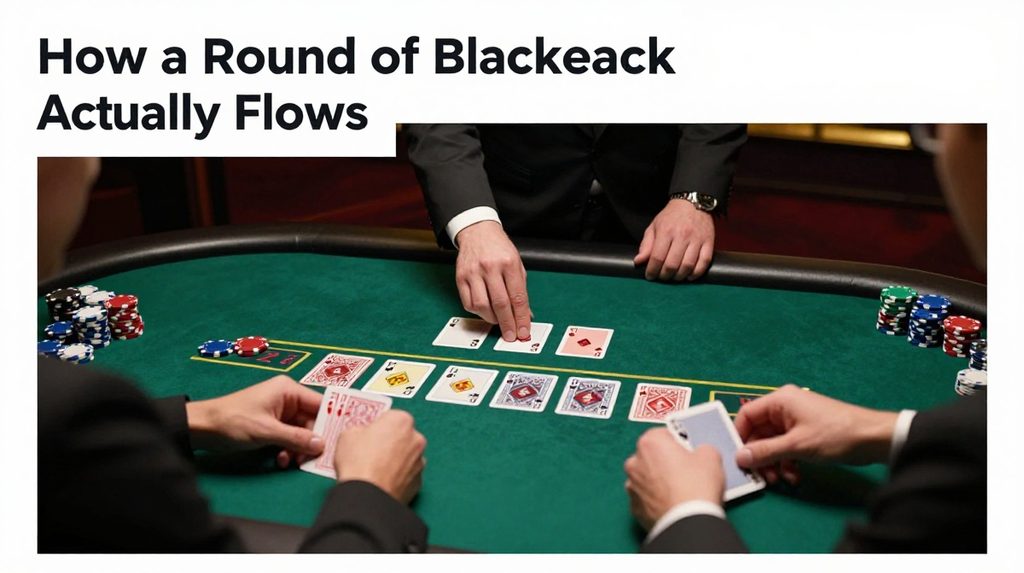
Here is the step-by-step sequence of a standard game.
Step 1: Bet first. Before any cards come out, you place your chips in the betting box in front of you. You cannot change your bet once the deal begins.
Step 2: Cards are dealt. You get two cards face up. The dealer takes one card face up and one face down. The face-down card is called the hole card and you won’t see it until later.
Step 3: Check your total. Add your two card values. You can also see the dealer’s face-up card, which gives you a clue about the strength of their hand.
Step 4: Make a decision. This is the heart of the game. Your choices are covered in the section below.
Step 5: The dealer’s turn. Once every player finishes their turn, the dealer flips over the hole card and plays their hand. The dealer follows fixed rules and cannot choose freely.
Step 6: Compare hands. Whoever has the higher total without going over 21 wins. If you and the dealer end on the same number, it is called a push and your bet is returned.
What the Dealer Must Do
The dealer has no freedom in how they play. In most games, the dealer must take another card hit if their total is 16 or below, and must stop stand if their total reaches 17 or higher. This rule does not change round to round, which means you always know what the dealer will do once you see their cards.
Your Four Choices at the Table
When it is your turn, you have these four options depending on the situation.
Hit: You ask for one more card. You can keep hitting as many times as you like, but if your total goes over 21, you bust and lose immediately.
Stand: You are happy with your total and stop taking cards. Your hand stays as it is.
Double Down: You double your original bet and receive exactly one more card, after which you must stand. This works well when your first two cards add up to 10 or 11 and the dealer is showing a weak card like a 4, 5, or 6. On a platform like lotus365 blue, free practice rounds are a good way to get comfortable with when doubling down actually makes sense.
Split: If your first two cards are a matching pair two 7s, two 8s, for example, you can split them into two separate hands by placing a second bet equal to your first. Each card then receives its own second card and you play both hands independently.
What a Natural Blackjack Means
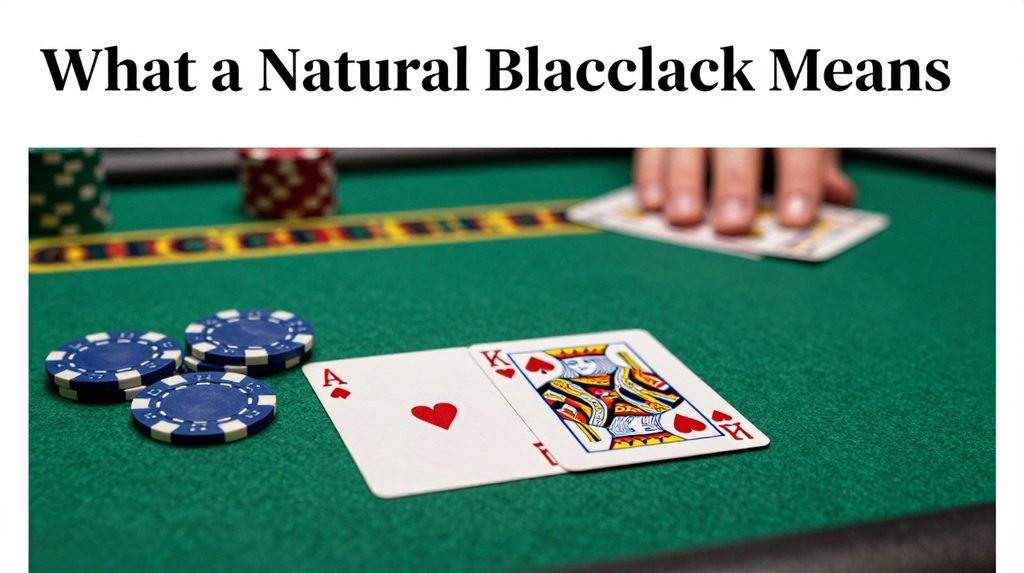
A natural blackjack is the strongest hand in the game. It happens when your first two cards are an Ace and any 10-value card a 10, Jack, Queen, or King. That gives you exactly 21 in two cards, and the dealer cannot beat it unless they also have a natural blackjack in which case the round is a push.
A natural blackjack usually pays 3:2. If you bet Rs. 500, you win Rs. 750 on top of getting your stake back. Some casino tables pay only 6:5 instead, which is noticeably worse for the player. Always confirm the payout ratio before you start.
Playing Blackjack in India
Physical casinos in Goa, Sikkim, and Daman are licensed and legal. You must carry valid government-issued photo ID and you must be at least 18 years old to enter.
For online play, the position changed in 2025. India’s Parliament passed the Promotion and Regulation of Online Gaming Act, 2025, which prohibits real-money online gambling at the federal level. Individual states like Telangana and Andhra Pradesh have added their own bans. Check the rules applicable in your own state before putting real money into any platform.
If you want to learn the game without any financial risk first, downloading the lotus365 apk lets you explore the interface, though real-money play carries both financial and legal considerations you should understand clearly beforehand.
A clear note: no card game guarantees winnings. Casino games involve risk, and money spent gambling can be lost entirely. If you find yourself spending more than you planned, that is a sign to step back. Speak to a family member or a financial counselor if you need support.